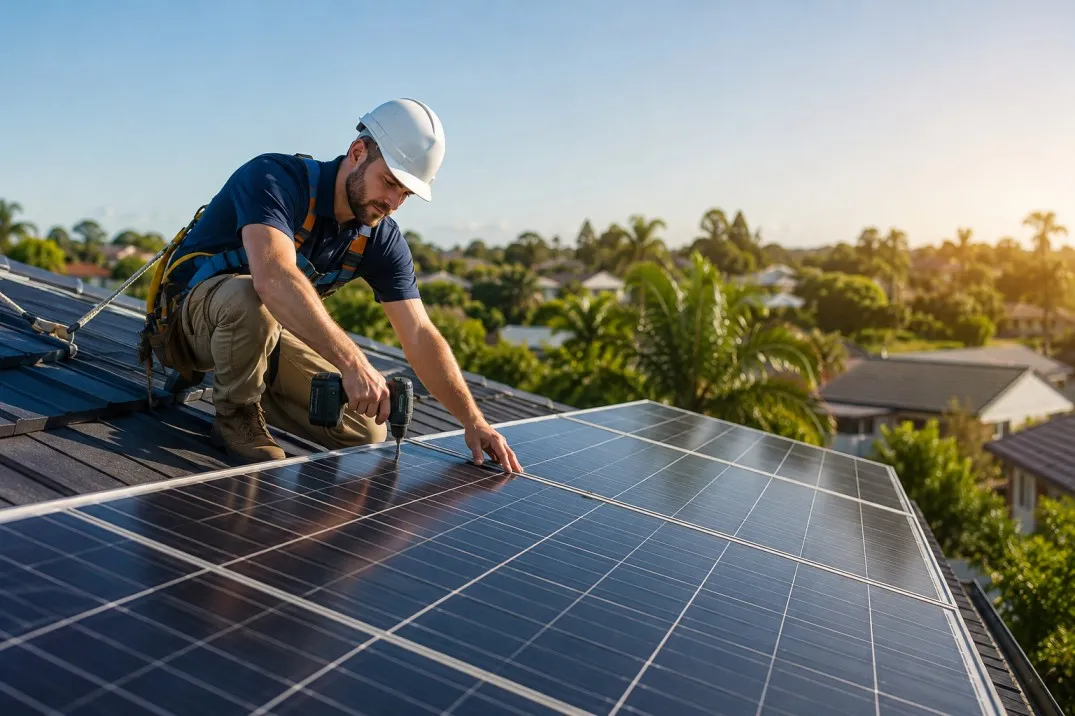
Choosing a solar installer is an important decision for any homeowner or business considering renewable energy. Solar panels can remain on a property for decades, so the company responsible for designing and installing the system can have a significant impact on its long-term performance.
For Gold Coast property owners searching for the best company installer, the lowest quote should not necessarily be the deciding factor. A quality solar installation involves system design, electrical work, product selection, compliance, warranties and ongoing support.
The right installer should be able to understand how a property uses electricity and then develop a system around those requirements.
The Australian Electrical Safety Office recommends using a licensed electrician for electrical work involving solar systems and advises consumers to check that their electrician is appropriately licensed.
1. Check Industry Accreditation and Qualifications
One of the first things to investigate is whether the installer has the appropriate industry credentials.
Solar installations involve specialised electrical and technical requirements. A reputable company should be transparent about the qualifications and accreditation of the people designing and installing its systems.
It's also important to understand that Australia's solar accreditation arrangements have changed. Solar Accreditation Australia is now responsible for the national installer and designer accreditation scheme, following the transition from the previous Clean Energy Council accreditation program.
For homeowners, this means checking the current accreditation status of the installer rather than relying solely on older references to CEC accreditation.
The Clean Energy Council consumer information provides guidance on finding approved sellers and checking installer accreditation.
In Queensland, electrical licensing is a separate and essential consideration. The Electrical Safety Office provides an online electrical licence search that consumers can use to check a contractor's licence status.
2. Look for Property-Specific System Design
A solar system should not be designed using a one-size-fits-all approach.
Every property has different electricity consumption patterns, roof characteristics, shading conditions, available installation areas and future energy requirements.
A good installer should look at how much electricity the property uses and when that electricity is consumed.
For example, a household with high daytime consumption may have different solar requirements from a family that uses most of its electricity in the evening.
The same applies to commercial properties. A business operating primarily during daylight hours may be able to use a substantial proportion of its solar generation directly, while another business may have very different load patterns.
The Clean Energy Council's consumer guidance has historically recommended obtaining a site-specific design and performance estimate when comparing solar retailers.
This remains a useful principle: understand what the proposed system is expected to achieve before comparing quotes purely on price.
3. Consider More Than Solar Panels
Modern energy systems can involve considerably more than photovoltaic panels.
Homeowners may be interested in:
- Solar panels
- Battery storage
- Backup power
- Off-grid solar
- EV charging
- Energy management
- Smart monitoring
- Commercial solar
- Future system expansion
A company that can assess these technologies together may be better positioned to create a long-term energy strategy.
For example, someone purchasing an EV today may have different energy requirements from someone who expects to purchase one in several years.
Similarly, a household considering battery storage may want its initial solar system designed with future energy storage in mind.
Thinking about these requirements before installation can reduce the likelihood of having to redesign the system later.
4. Check the Products Being Offered
The installer is important, but so are the components being installed.
Solar panels, inverters, batteries and EV charging equipment should be selected based on suitability, quality and compatibility rather than simply the advertised price.
Australian product requirements also change over time.
The Clean Energy Council maintains approved product information covering relevant solar and battery equipment, while its current guidance explains changes to standards and product approval requirements.
For example, new applications for PV modules on the approved list now need to meet updated standards, with further requirements applying from 2026.
This is another reason homeowners should ask for the exact product model numbers in a quotation.
Rather than accepting a quote that simply says "premium panels" or "quality inverter", ask for the manufacturer and model.
That makes it possible to research the equipment and compare like-for-like proposals.
5. Understand the Warranty
Solar equipment can have multiple warranties, and they do not necessarily cover the same things.
When comparing installers, ask about:
Product warranties
These are provided by manufacturers and can apply separately to solar panels, inverters, batteries and other equipment.
Workmanship warranties
These relate to the installation itself and may be provided by the installer.
Performance warranties
Some solar panels have warranties relating to their expected power output over time.
Battery warranties
Battery warranties can include conditions around capacity retention, cycles and operating conditions.
The important point is to understand who is responsible for each part of the system.
A strong installation company should be able to explain the warranty arrangements clearly before you sign a contract.
Queensland guidance also recommends keeping installation documentation, warranty information and maintenance records for future reference.
6. Ask Who Actually Performs the Installation
It is worth asking a straightforward question before choosing a solar company:
Who will install my system?
Some businesses manage sales and design while subcontracting the physical installation to another company.
That is not automatically a problem, but homeowners should understand the arrangement and know who is responsible for the work.
If installation is handled by an internal team, it can provide a clearer line of communication between the people who designed the system and those carrying out the work.
The Clean Energy Council's consumer resources have highlighted the distinction between retailers, designers and installers and encouraged consumers to understand who is involved in their solar project.
When comparing companies, ask whether installation is completed by their own electricians or subcontractors and who you should contact if an issue arises.
7. Look at the Company's Approach to Customer Service
Solar is a long-term investment, so the relationship with the installer should not end when the panels are switched on.
Good communication can make a major difference throughout the process.
Before installation, customers should receive clear information about:
- System design
- Expected performance
- Equipment specifications
- Installation arrangements
- Price
- Warranty terms
- Payment conditions
- Grid connection requirements
- Monitoring
- Maintenance
After installation, customers may need assistance with monitoring, troubleshooting, warranty questions or future upgrades.
Queensland's Electrical Safety Office notes that solar systems should be maintained appropriately and recommends using qualified professionals for electrical work.
That makes after-sales support another useful consideration when comparing the best company installer options.
Why the Cheapest Quote Isn't Always the Best Choice
Price naturally matters when investing in solar.
However, comparing systems solely on the initial dollar figure can make it difficult to identify the true value of each proposal.
Two quotes may look similar while offering different:
- Solar panel specifications
- Inverter technology
- Battery capacity
- Installation standards
- Warranty coverage
- Monitoring systems
- Backup functionality
- Workmanship coverage
- Customer support
A lower price may be attractive, but it is important to establish exactly what is included.
The better comparison is often the total value of the system over its expected operating life.
What Makes a Strong Solar Installer?
The best company installer for one property may not necessarily be the best choice for another.
A suitable installer should be able to demonstrate a combination of technical capability, appropriate licensing, quality equipment, careful system design and good customer communication.
For a residential customer, that could mean designing a system around household consumption and future battery or EV requirements.
For a commercial customer, it could involve analysing business operating hours and larger electrical loads.
For a rural property, the priorities may include off-grid capability, battery storage and energy resilience.
The right installer begins with the customer's requirements rather than starting with a predetermined package.
Residential, Commercial and Off-Grid Requirements Are Different
One of the clearest signs of an experienced solar company is an ability to understand different project types.
Residential solar
Residential systems generally focus on reducing grid electricity purchases and making effective use of available roof space.
Battery storage may be considered where the household wants to shift solar energy into evening hours or provide backup power.
Commercial solar
Commercial projects often involve larger system sizes and more detailed analysis of business electricity consumption.
A commercial installation may be designed around the company's operating schedule to maximise the amount of solar energy consumed on-site.
Off-grid solar
Off-grid properties have different requirements again.
Without a conventional grid connection, the system must be designed to provide adequate energy throughout the year.
Solar generation, battery storage, inverter capacity, backup generation and energy consumption all need to be considered together.
For these projects, system design is particularly important.
Energy Solution Centre's Gold Coast Approach
Energy Solution Centre is based at 19 Price St, Nerang and specialises in renewable energy solutions across residential, commercial and off-grid applications.
The company describes its approach as tailored rather than one-size-fits-all, with solutions covering solar power, battery storage, off-grid systems and EV charging.
Its Gold Coast team works with different solar and energy storage brands, allowing system recommendations to be based on the requirements of the property rather than a single product range.
For customers comparing the best company installer options, the company's focus on customised energy solutions is particularly relevant because solar requirements can vary considerably between homes, businesses and rural properties.
Questions to Ask Before Signing a Solar Contract
Before choosing an installer, consider asking these questions:
Is the system designed specifically for my property?
A proper proposal should reflect your electricity consumption and property characteristics.
What equipment is included?
Request exact manufacturer and model information.
Who will install the system?
Confirm whether installation is performed by the company's own team or subcontractors.
Are the installers appropriately licensed and accredited?
Ask for relevant licence and accreditation details and verify them independently where appropriate.
What happens if something goes wrong?
Understand who provides after-sales support and how warranty claims are handled.
Can the system be expanded later?
If you may add a battery, EV charger or additional solar capacity, discuss this during the initial design.
What will the system actually produce?
Ask for realistic performance estimates and the assumptions behind them.
What is excluded from the quotation?
This can include switchboard upgrades, additional electrical work, structural work or other project-specific costs.
A Local Installer Can Offer Practical Advantages
For Gold Coast homeowners and businesses, working with a local solar company can make communication and site assessment more straightforward.
A local team can visit the property, assess its specific characteristics and discuss the energy goals directly with the customer.
That can be particularly valuable for more complicated installations, such as large solar arrays, battery systems, commercial projects or off-grid properties.
However, being local should not be the only selection criterion.
Consumers should still check licensing, accreditation, product quality, warranties, experience and customer service.
Final Takeaway
Finding the best company installer for solar is about more than finding a low price or choosing the most recognisable brand.
The strongest candidates should offer appropriate qualifications, property-specific design, quality products, transparent warranties, qualified installation and ongoing customer support.
For Gold Coast property owners, it also makes sense to consider the wider energy picture. Solar panels may be only the first step, followed by battery storage, EV charging or other technologies as energy needs change.
Taking time to compare installers carefully can help ensure that the final system is designed around the property, the budget and the customer's long-term energy goals.
Frequently Asked Questions
What should I look for in the best company installer?
Look for appropriate licensing and accreditation, experience, property-specific system design, quality equipment, clear warranties and reliable customer support.
Should I choose the cheapest solar installer?
Not necessarily. Compare the complete system, equipment, installation standards, warranties, expected performance and after-sales support rather than focusing only on the initial price.
Does the best company installer need to be local?
Local knowledge can be helpful, particularly for site assessments and ongoing support, but licensing, experience, system design and service quality should also be considered.
How do I check whether a Queensland electrician is licensed?
The Queensland Electrical Safety Office provides an online Electrical Licence Search where consumers can check electrical contractor licence information.
Should I consider batteries when choosing a solar installer?
Yes. If battery storage is a possibility now or in the future, discuss it during the initial design. The solar system and electrical infrastructure may need to be planned with future storage requirements in mind.