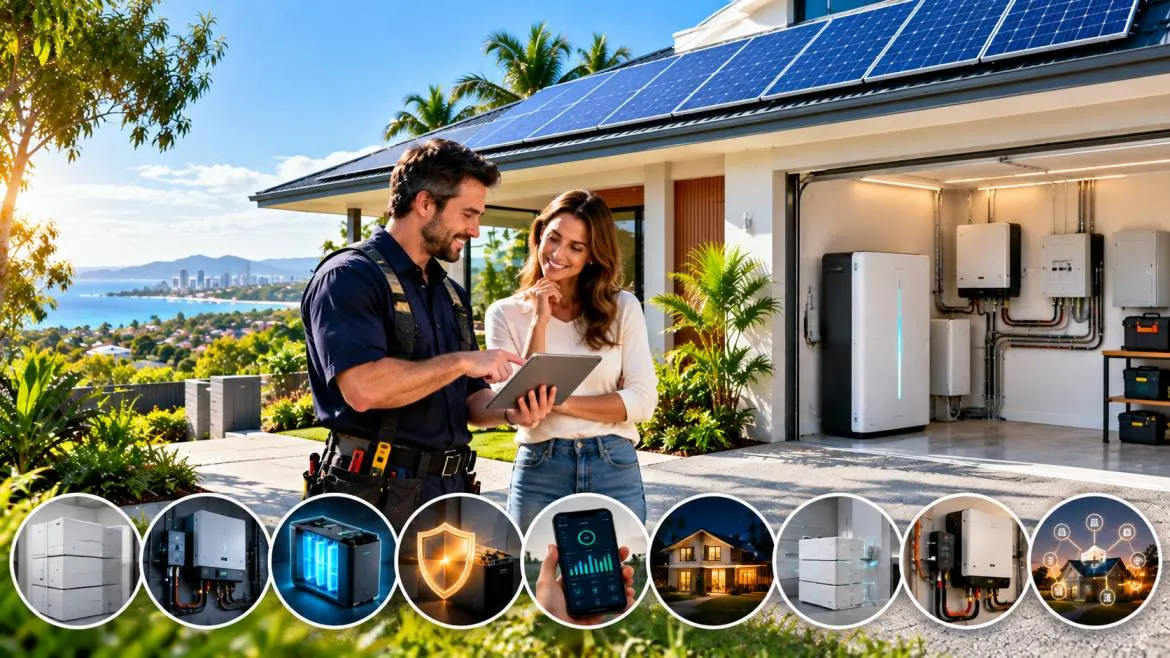
Solar power has become a practical energy solution for many Australian households, particularly across sunny regions such as Southport and the wider Gold Coast. But while rooftop solar panels can generate plenty of electricity during the day, household energy use does not always follow the same schedule.
That is where battery storage can become useful. A solar battery can store excess electricity generated during the day and make that stored energy available later when solar production falls.
However, choosing the best solar battery is about more than choosing the biggest capacity or the cheapest package. Homeowners need to consider battery performance, usable capacity, safety, warranty conditions, compatibility and installation quality.
If you are considering battery storage for your Southport home, here are ten features worth examining before making a decision.
1. Usable Battery Capacity
Battery capacity is usually expressed in kilowatt-hours, or kWh. It indicates how much energy the battery can store.
However, homeowners should pay close attention to usable capacity, rather than simply looking at the headline capacity shown on a product advertisement.
Usable capacity represents the amount of stored energy that can actually be made available for household use.
For example, a household with high evening electricity consumption may require considerably more usable storage than a smaller household with lower energy demand.
The Australian Government provides detailed information about solar batteries, including battery capacity, storage and household energy use, through its official battery guidance.
Before choosing a battery, look at your recent electricity bills and consider how much electricity your household typically uses after the sun goes down.
2. Power Output
Battery capacity and power output are not the same thing.
Capacity tells you how much energy can be stored, while power output indicates how much electricity the battery can deliver at a particular time.
This distinction can become important when several appliances are operating simultaneously.
For example, a household might use air conditioning, refrigeration, lighting, cooking appliances and entertainment equipment during the evening. A battery with a large capacity may still have limitations if its power output is not suitable for the household's requirements.
If backup power is important, power output becomes even more relevant.
Ask an installer to explain both the battery's usable capacity and its continuous and peak power specifications before comparing different models.
3. Round-Trip Efficiency
No battery stores and returns energy with 100 per cent efficiency.
Some energy is lost during the charging and discharging process. Round-trip efficiency provides an indication of how much of the energy put into a battery can subsequently be recovered.
Higher efficiency can help a household make better use of its available solar generation.
Nevertheless, efficiency should not be considered in isolation.
A battery with excellent efficiency but unsuitable capacity, insufficient power output or poor warranty conditions may not be the right choice.
The best approach is to compare efficiency alongside the other specifications that affect real-world performance.
4. Safety and Product Approval
Safety should always be one of the first considerations when researching home battery storage.
Australian homeowners should check whether the battery being proposed appears on the relevant Clean Energy Council approved products list.
The Clean Energy Council's Approved Batteries list provides consumers and industry participants with information about approved battery products.
Product lists can change over time, so it is better to check current information rather than relying on an old brochure, online review or recommendation from several years ago.
Installation location is also important. Your installer should explain where the battery will be positioned and how the installation will meet applicable electrical and safety requirements.
5. Warranty Conditions
A solar battery can represent a substantial investment, so warranty conditions deserve careful attention.
A warranty should not be judged solely by the number of years advertised.
Homeowners should understand what the warranty actually covers.
Depending on the manufacturer, relevant conditions may include:
- Product defects
- Capacity retention
- Performance requirements
- Cycle or throughput limits
- Replacement conditions
- Parts
- Labour
- Warranty claim procedures
It is also worth asking how warranty claims are handled in Australia.
A straightforward warranty process can make a significant difference if an issue occurs several years after installation.
6. Backup Power Capability
Many homeowners associate batteries with backup power, but not every battery installation provides the same level of backup.
Some systems can provide electricity to selected circuits during a blackout, while other configurations can provide broader backup functionality.
If backup power is one of your main reasons for considering a battery, ask specific questions before signing a contract.
For example:
- Which circuits will receive backup power?
- Can essential appliances continue operating?
- Will the whole house be backed up?
- Is additional equipment required?
- Can solar recharge the battery during an outage?
- How quickly does the system switch to backup power?
The answer will depend on the battery, inverter, system design and installation configuration.
7. Compatibility With Your Existing Solar System
If you already have solar panels, battery compatibility should be considered before choosing a product.
Your existing inverter, solar system architecture and electrical configuration can affect which batteries can be installed.
Some systems may allow relatively straightforward battery integration, while others may require additional equipment or changes to the existing system.
A professional assessment can identify potential compatibility issues before installation begins.
This can also help avoid unexpected costs later in the project.
8. Monitoring and Energy Management
Modern battery systems can provide homeowners with considerably more information than traditional solar installations.
Many systems include mobile applications or online monitoring platforms that allow users to see information such as:
- Solar generation
- Household electricity consumption
- Battery charge level
- Battery discharge
- Grid imports
- Grid exports
- Energy production history
This information can help homeowners understand how their system is performing and identify patterns in household energy use.
For readers who want a broader explanation of the technology itself, the Battery Energy Storage System article on Wikipedia provides an overview of how battery storage systems operate.
9. Installation Quality and Local Support
A high-quality battery product still needs a properly designed and installed system.
Electrical work, system configuration, equipment placement and commissioning can all influence the overall performance of a battery installation.
Local support can also be valuable.
Homeowners in Southport and Chirn Park may prefer to work with a business that understands the local area and can provide face-to-face assistance when required.
Energy Solution Centre Chirn Park provides solar, battery storage and EV charging solutions from its location on Musgrave Avenue in Southport.
Having access to a local team can make it easier to discuss system requirements, ask questions and arrange support after installation.
10. Overall Value
The lowest-priced battery is not necessarily the most suitable option.
When comparing battery systems, homeowners should consider the complete value of the installation.
That can include:
- Usable battery capacity
- Power output
- Efficiency
- Warranty
- Product approval
- Installation quality
- Monitoring
- Backup capability
- Manufacturer support
- Long-term suitability
Government support can also affect the overall cost of an eligible installation. Homeowners can review the current Australian Government information on solar and batteries before comparing quotes.
The important point is to compare complete systems rather than focusing on one number.
How to Choose the Right Battery for Your Home
There is no universal battery size or specification that works for every Southport property.
Start by looking at your household's actual electricity consumption.
When do you use the most electricity?
How much solar energy is being exported during the day?
How much electricity is being purchased from the grid in the evening?
Do you want backup power?
Are you planning to add an electric vehicle or increase your household's electricity consumption in the future?
The answers to these questions can help determine what type of battery system may be appropriate.
A professional installer should be able to explain why a particular battery size and configuration has been recommended.
Why Battery Sizing Matters
Oversizing and undersizing can both create problems.
A battery that is too small may regularly reach full capacity while excess solar continues to be exported to the grid.
On the other hand, a battery that is considerably larger than your household's realistic energy requirements may not provide the value you expect from the additional capacity.
Good system design is therefore about matching storage to actual energy patterns.
This is one reason why a personalised assessment can be more useful than simply selecting a standard package advertised online.
Final Thoughts
Finding the best solar battery involves looking beyond brand names and advertised prices.
Usable capacity, power output, efficiency, safety, warranty, compatibility and backup functionality all deserve attention.
Southport homeowners should also consider the quality of installation and the level of support available after the system has been commissioned.
A well-designed battery system should complement the home's existing solar generation and electricity consumption rather than simply adding storage for the sake of having a battery.
By comparing the complete system and asking the right questions before installation, homeowners can approach battery storage with a much clearer understanding of what they are purchasing.
FAQs
What makes the best solar battery for a Southport home?
The right battery depends on household electricity consumption, solar generation, usable capacity, power output, warranty, safety and whether backup power is required.
How much battery storage does a home need?
There is no single answer. The appropriate size depends on electricity consumption, solar generation and how much energy the household wants to use after sunset.
Are all batteries approved for Australian installations?
No. Homeowners should check the current Clean Energy Council Approved Batteries list and discuss product eligibility with their installer.
Can a solar battery provide backup power?
Some systems can provide backup power, but the amount of backup available depends on the battery, inverter, system configuration and installation.
Can a battery be added to existing solar panels?
Often, yes. However, compatibility depends on the existing solar system and electrical equipment, so a professional assessment is recommended.